
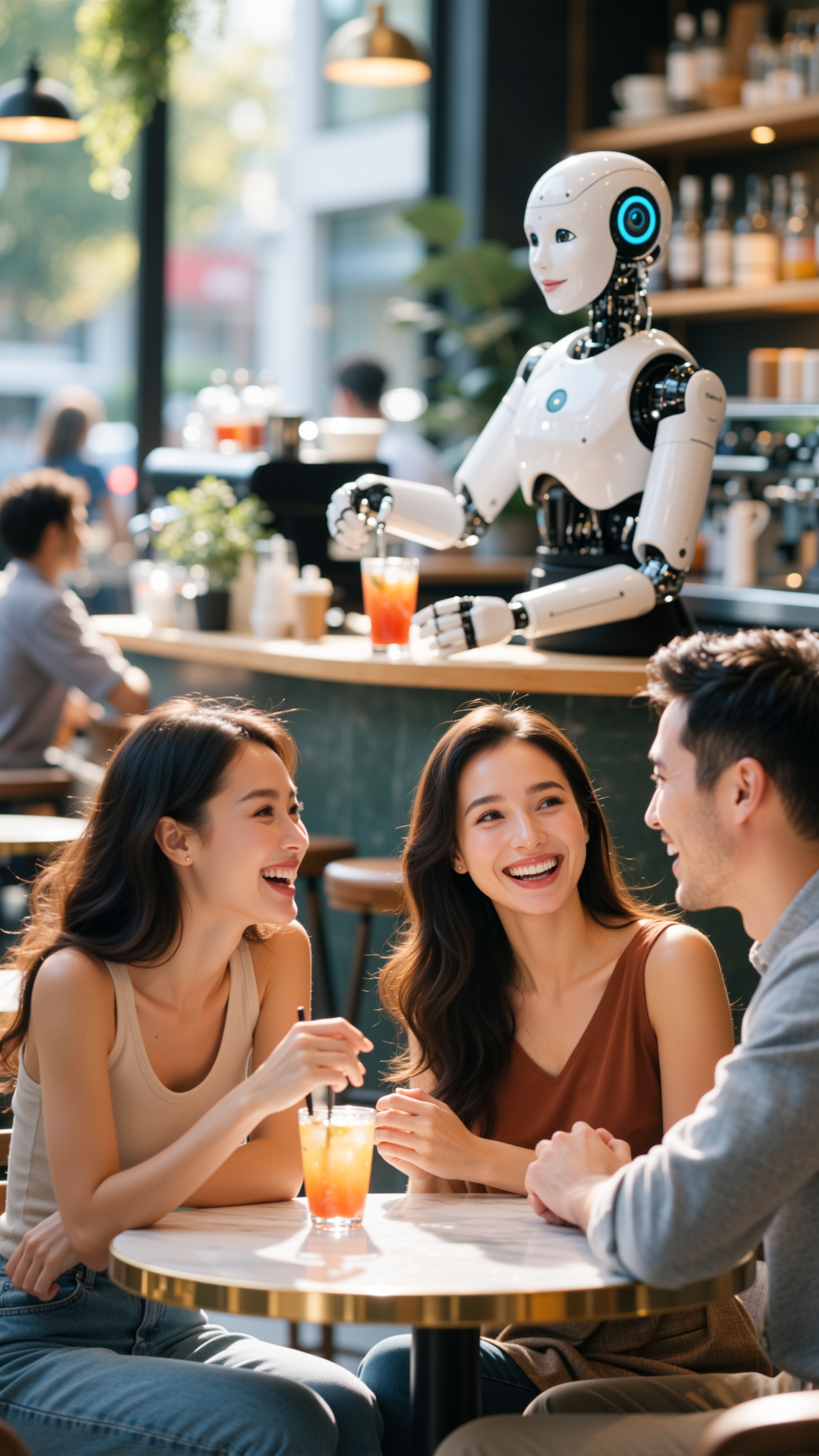
 Product Image
Restaurant Service Robot
An intelligent food delivery robot for restaurants, combining food delivery, ordering, and guest greeting. Helping restaurants upgrade front-of-house service with low cost, high efficiency, and low error rates.
Restaurant traffic peaks are usually concentrated in just a few hours at lunch and dinner, and whether the front-of-house service can keep pace with table turnover directly determines a venue's revenue ceiling. Under the traditional manual delivery model, servers carry trays back and forth between tables and the pass, remembering the order sequence of every table while handling rush requests, misdeliveries and spills during peak hours. Once staff get busy, service quality fluctuates with them.
The restaurant service robot is a front-of-house assistant designed for exactly these high-frequency pain points. It cruises autonomously along landmark lines, moving steadily between tables and delivering dishes precisely to the designated table; it also carries an ordering screen and greeting guidance functions, so guests can browse the menu and add dishes by themselves once seated, while the robot proactively greets and seats guests at the entrance, freeing servers from repetitive physical trips and leaving their energy for the service moments that truly need a human touch.
Measured Comparison: Manual Delivery vs. Robot Delivery
Using a mid-sized Chinese restaurant with moderate traffic as our sample, we ran a side-by-side comparison across three dimensions: cost, efficiency and error rate. The data below is based on a single-day operating estimate, for reference when a venue evaluates return on investment:
| Comparison Dimension | Traditional Manual Delivery | Restaurant Service Robot |
|---|---|---|
| Average Monthly Labor Cost | 2 dedicated delivery staff, about RMB 8,000-10,000 per month | Amortization of 1 unit plus electricity and maintenance, about RMB 1,500-2,500 per month |
| Delivery Efficiency at Peak Hours | Only 1-2 tables per trip per person, prone to congestion and queues | Continuous cruising 7×24 hours, parallel delivery to multiple tables |
| Error Rate | Errors under peak pressure, about 2-3 mistakes or omissions per 100 orders on average | Precise positioning via landmark navigation, error rate approaching zero |
| Table Turnover Handover | Depends on staff experience and shift scheduling, handovers easily fall out of sync | Unified back-office dispatching, automatically stands by when idle |
As the table shows, the robot has a clear structural advantage in cost and efficiency: labor costs accumulate linearly over time, while equipment investment is amortized as a one-off cost that keeps diluting; delivery efficiency upgrades from "one table per person per trip" to "multiple tables in parallel", so servers no longer need to weave back and forth through the aisles during peak hours. Notably, the difference in error rate is the easiest to underestimate — wrong and missed deliveries lead to complaints and refunds, and this hidden loss often far exceeds the visible labor cost.
Deployment Recommendations for Venues
The applicable scenarios for the restaurant service robot are clear: mid-to-large Chinese restaurants, hot pot and barbecue venues with high table turnover and frequent delivery benefit most; boutique restaurants with high average spend and a focus on dedicated service can position it as an auxiliary food-running tool and keep a human-led service rhythm. When introducing it, we recommend first deploying 1-2 units for a two-week trial during the lunch peak, then gradually adding more once the routes and dispatching are running smoothly.
Mass production relies on standardized production lines in an automated factory, and every unit undergoes aging tests and multiple rounds of quality inspection before leaving the factory, ensuring equipment stability.
Conclusion
For restaurant venues pursuing efficiency and controllable costs, the restaurant service robot is not a novelty add-on but an operating tool with quantifiable returns: a single unit can cover the workload of two delivery staff, often paying back the investment within six months, while significantly reducing wrong-order complaints and shifting front-of-house service from "relying on people to carry it" to "relying on a system to back it up". If you are evaluating a digital upgrade for your venue, we recommend starting with delivery, the highest-frequency route, and validating the results at the lowest possible cost.