
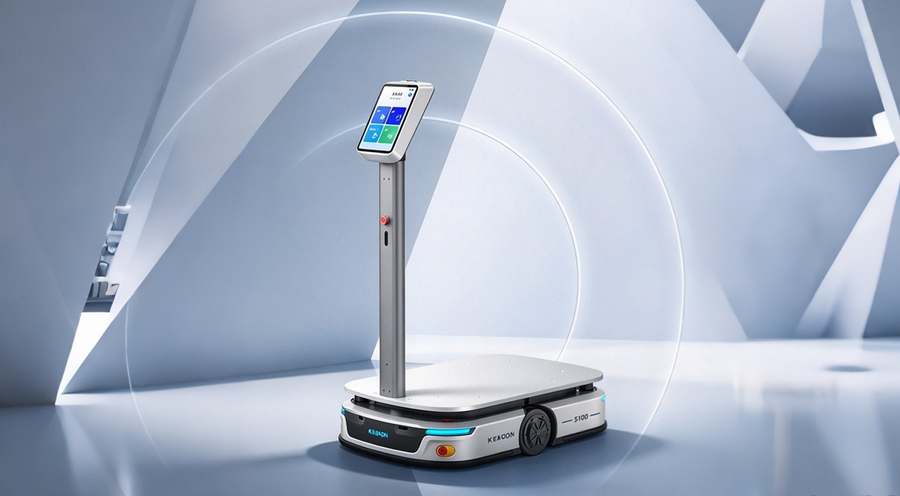
 Product Image
Keenon S100 Heavy-Load Autonomous Mobile Robot
A 100 kg+ payload autonomous mobile robot with a 925 x 640 x 1,282 mm footprint, 90 cm minimum aisle, LiDAR SLAM and stereo vision navigation, three charging options and a 2.5-hour fast charge.
The Keenon S100 is a heavy-load autonomous mobile robot built to move pallets, totes, shelves and carts through working buildings. Its flat platform carries more than 100 kg, while the compact 925 x 640 mm footprint and 90 cm straight-aisle clearance let it work in storage areas that were not designed around a large automated guided vehicle.
100 kg+ on a 90 cm aisle
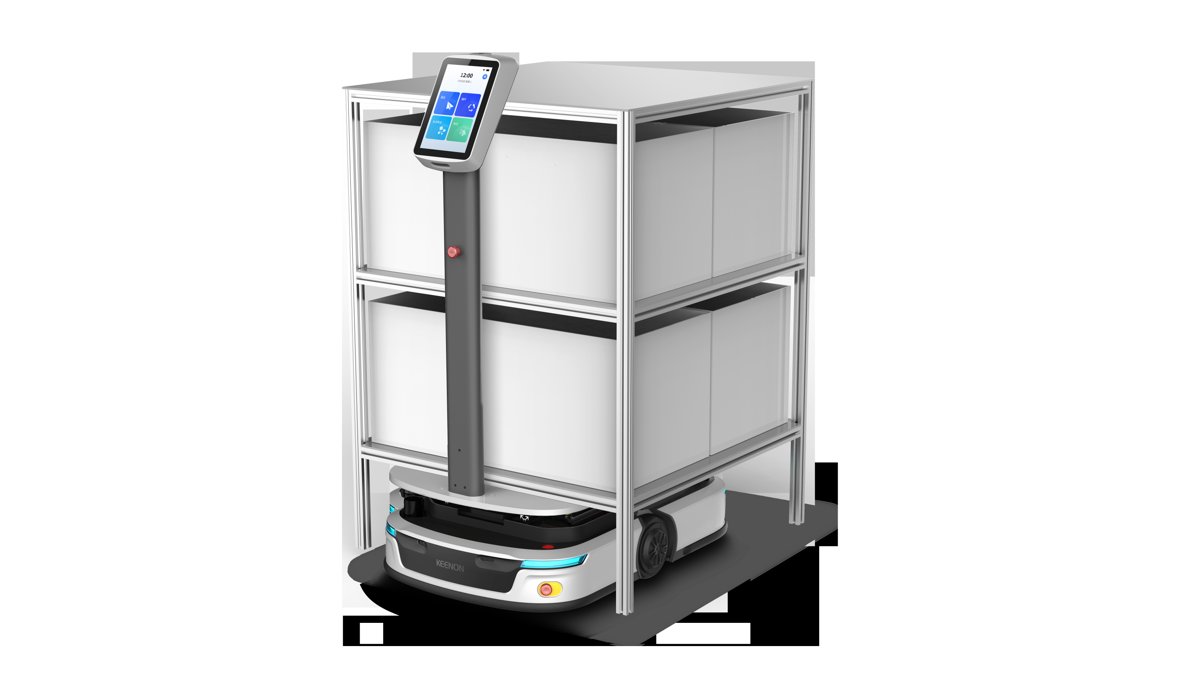
The S100 is rated for a maximum payload of more than 100 kg (220 lb+). The loading platform measures 865 x 600 x 800 mm, so it can accept standard totes, shelf frames and custom fixtures rather than forcing every load into a proprietary bin. The robot itself weighs 87.5 kg with the battery, which keeps the vehicle stable while leaving enough payload margin for real warehouse loads.
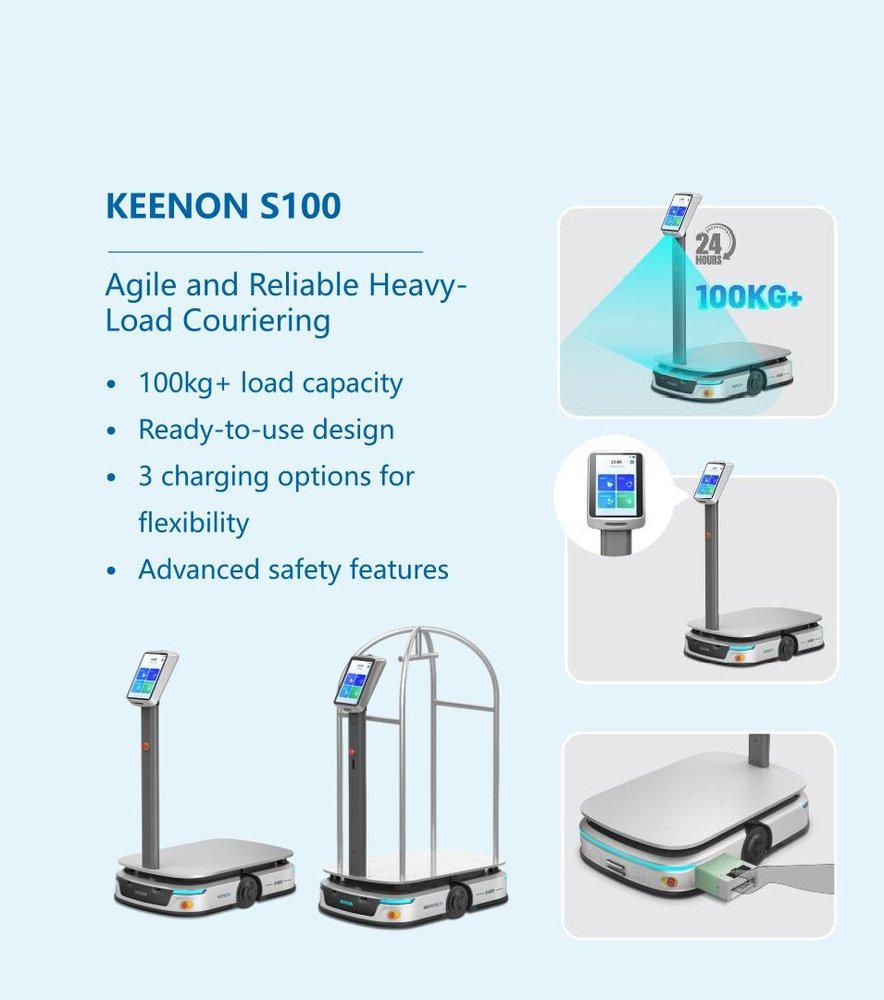
The 90 cm minimum aisle is measured without rotating. That distinction matters during layout planning: the S100 can pass through a narrow aisle, but it still needs a turning envelope at the end of the run. The maximum speed is 1 m/s, which is appropriate for a shared workspace where people, forklifts and pallet trucks are moving at the same time.
一个平台,多种物料搬运模式
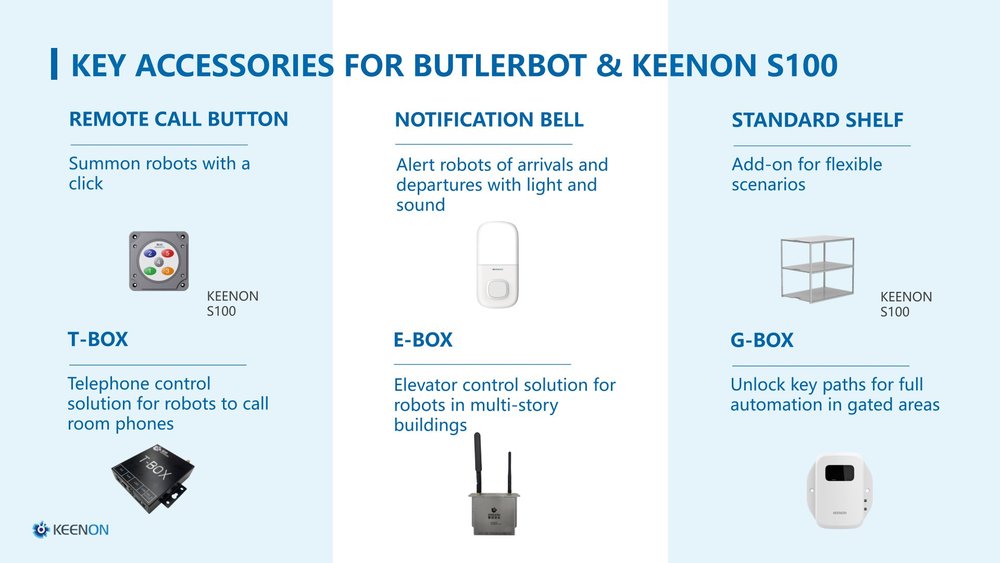
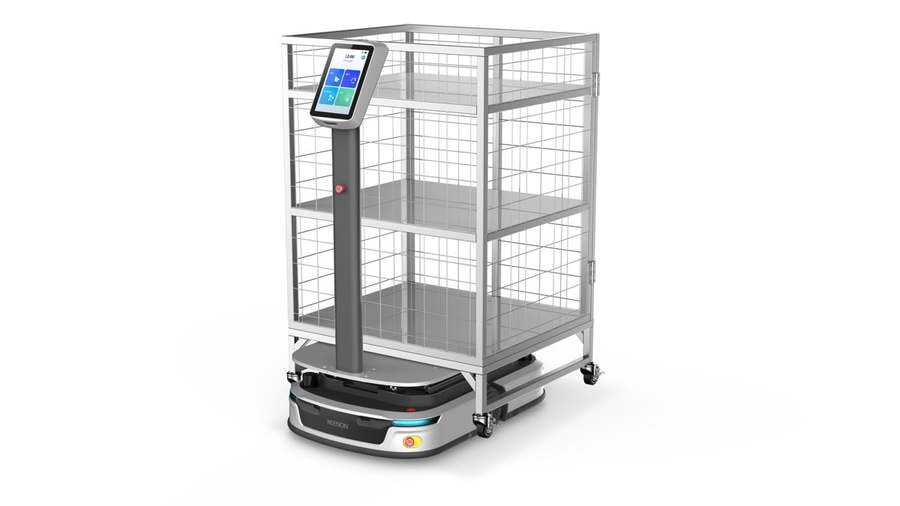
The S100 can be used as a bare platform, with a standard shelf, or with a mesh cage for loose goods. The accessory range includes a remote call button, a notification bell, the standard shelf, a T-BOX for room-phone control, an E-BOX for elevator control and a G-BOX for gates and controlled access points. That lets a site start with a simple transport route and add building integration later without replacing the robot.
Navigation for live warehouse traffic
Navigation combines LiDAR SLAM with stereo vision. The supplier describes AI-based path planning at millisecond response, with the robot replanning around people, pallets and temporary obstructions instead of following a fixed magnetic strip. For a warehouse aisle that changes during the day, that is the difference between a route that works on the layout drawing and a route that keeps working after the first pallet is parked in the wrong place.
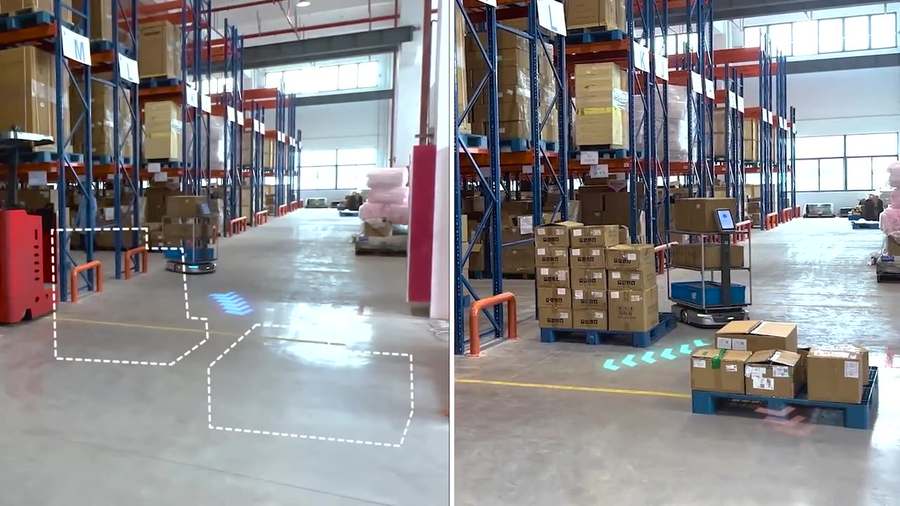
The S100 is positioned for electronics plants, auto-parts workshops, warehouses, logistics hubs and other sites that move heavy containers over repeated indoor routes. It is not an outdoor vehicle, and the source specification does not claim a weather rating. The deployment plan should therefore keep the route indoors and define a clear handover point at each end.
Ready to run, not a six-week integration project
The robot ships with its operating system and application software already installed. The supplier presents this as a ready-to-use deployment model: the site maps the route, teaches the stops and starts moving loads without building a custom stack from scratch. That is useful for a first automation project, but it does not remove the need to define who owns the map, the route logic and the exception process after handover.
Charging that fits shift work
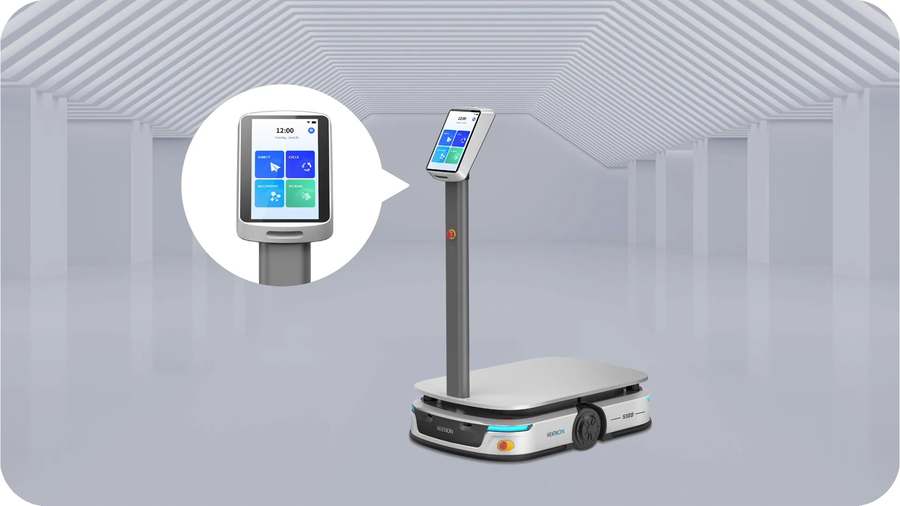
The S100 supports automatic charging, manual charging and battery swap. A 0-100% charge takes about 2.5 hours with the charger or charging dock. The source page states up to 8 hours of runtime under loads below 100 kg, and separately describes about 6 hours at full load. Both figures depend on route length, stops, floor conditions and payload, so a pilot should measure the actual duty cycle rather than treating either number as a fixed shift length.
安全围绕负载层层构建
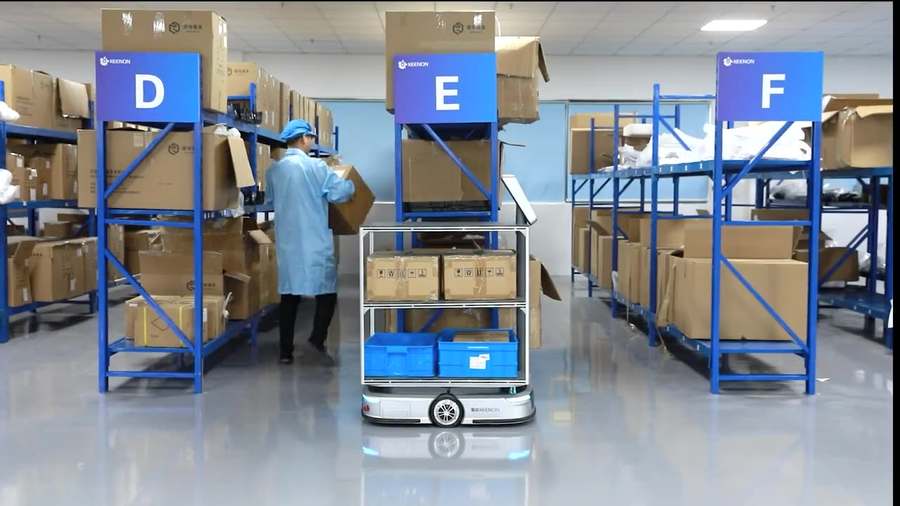
安全套件包含三台立体视觉相机、两台激光雷达、一台 VSLAM 传感器和三个急停按钮。机器人会在自身周围投射检测区域,当有人或物体进入路径时自动减速或停止。重载平台必须配备此类冗余设计:单个传感器若未能检测到托盘底部或行走的工人,将构成不可接受的安全风险。
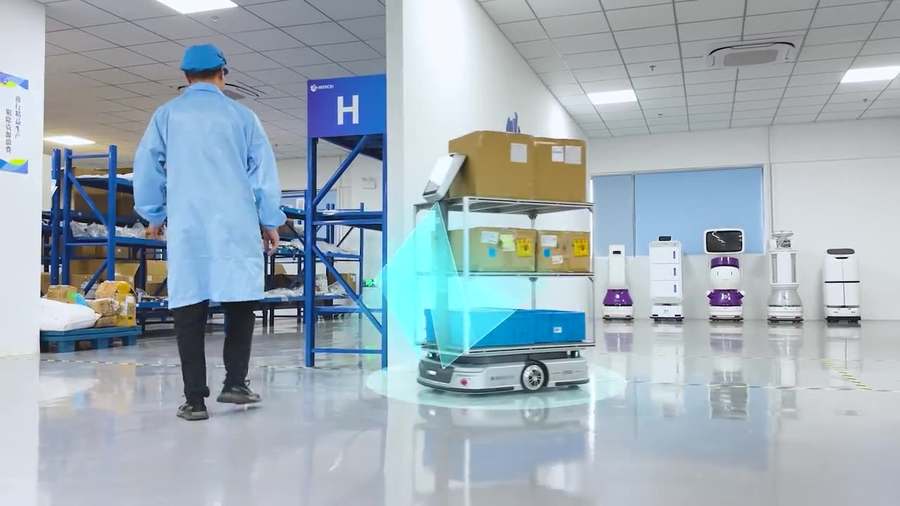
Even with those layers, the site remains responsible for traffic rules, pedestrian walkways, blind corners and the handover procedure at each stop. The S100 is designed to avoid collisions, not to replace a site risk assessment.
Where the S100 fits
The strongest fit is a repetitive indoor movement of heavy totes or carts: raw material from storage to a production line, finished goods from a line to packing, or supplies from a central store to several departments. The source page also names electronics, automotive parts and logistics operations. The common requirement is a route that repeats often enough to justify a dedicated robot and a payload that is too heavy for a small delivery platform.
What to plan before deployment
A heavy-load AMR changes traffic flow, not just a single task. Before ordering, measure the narrowest aisle, the turning space at each end, the floor transitions, the lift dimensions and the clearance around every stop. Then run a pilot during a real shift, because a quiet warehouse can hide the congestion that appears when several people and pallet trucks share the route.
- 确认每一路段的路线宽度、转弯包络和地面状况。
- 决定货物是放置在裸平台、货架还是网笼中。
- Confirm whether T-BOX, E-BOX and G-BOX integrations are included in the quoted scope.
- Check the charger or dock location and who will perform a manual battery swap.
- Define the handover point and the exception process when a route is blocked.
Commercial notes
货源挂牌价为人民币 58,000,并参考显示美元 8,628.38。页面包含两项保修声明:产品摘要列明一年有限保修,企业采购部分提及三年全国服务期。下单前须与供应商确认最终合同、交付范围、配件清单及服务等级。
Optional accessories and building-control boxes are quoted separately from the standard robot package. The package list below follows the source page and should be checked against the final quotation.
Product film
The manufacturer's product film shows the S100 moving loads in an industrial environment. It is included as source material for the product page.
What ships with the robot
The standard package listed on the source page contains the robot, charger, charging dock and manual. Optional shelves, cages and control boxes are configured separately.
- 机器人 x 1
- Battery charger x 1
- Charging dock x 1
- Product manual x 1